See here. Thanks, Tori (and Jennifer)!
(And yes, my post-deanship portraits are better....)
Tampilkan postingan dengan label Teaching. Tampilkan semua postingan
Tampilkan postingan dengan label Teaching. Tampilkan semua postingan
Selasa, 07 Mei 2013

Kamis, 18 April 2013
Rabu, 17 April 2013
For my law faculty colleagues--something free.
Jennifer Robbennolt & Jean Sternlight's book, Psychology for Lawyers, is a marvelous way to introduce students to the way that people (yes, including lawyers) perceive the world. It's useful for students who plan to be litigators and for students who want to do deals. Like every other ABA book, though, it's pretty pricey. But here's the good news:
If you're interested, contact Jean at jean.sternlight@unlv.edu.
The ABA will provide you with some individual chapters for FREE to you and your students.
If you're interested, contact Jean at jean.sternlight@unlv.edu.
Sabtu, 26 November 2011
Sabtu, 19 November 2011
Newest "guilty pleasure" blog--update.
See here. Hat tip to Brian Leiter.
UPDATE: From my buddy George Connelly: In my humble opinion, the "feel good" aspects of lower and higher education have created at least 2 generations of students who do not know how to spell, punctuate, or write. And so long as grade inflation exists in the schools, that will continue.
UPDATE: From my buddy George Connelly: In my humble opinion, the "feel good" aspects of lower and higher education have created at least 2 generations of students who do not know how to spell, punctuate, or write. And so long as grade inflation exists in the schools, that will continue.
Selasa, 25 Oktober 2011
Sabtu, 01 Oktober 2011
Congrats to my buddy Jennifer Carr!
Jennifer's paper, Providing Effective Feedback, was recently listed on SSRN's Top Ten download list for Law Educator: Courses, Materials & Teaching eJournal. Yay, Jennifer!
Jumat, 08 April 2011
An open letter to Nevada's governor and legislature and to the Board of Regents.
I was hoping to be able to speak at today's special meeting of the Board of Regents, during the public comment session, but I had to leave to teach my class later this morning. Here's what I would have said:
You have a very difficult task in front of you, with Nevada's budget situation getting worse every day, and I don't envy you. I did want to give you a feel for how some of the research done at the Boyd School of Law contributes directly to Nevadans and to the country as a whole.
First, some bragging about our students. I'm one of the faculty advisors to the Gaming Law Journal and the Nevada Law Journal (lexis.com). Those two magazines publish both faculty research (not just our faculty's research, but the research done by scholars elsewhere as well) and student research. The GLJ is still rather young, but the NLJ's research has been cited by courts here in Nevada, including the Nevada Supreme Court, and by other courts. One of the country's most famous and well-regarded judges, the Hon. Richard Posner of the United States Court of Appeals for the Seventh Circuit, has cited the NLJ more than once. By publishing useful and high quality research, our students are providing courts with the means to make good decisions.
Second, the research that I'm doing in terms of bankruptcy ethics (the behavior of bankruptcy lawyers) is part of my overall research agenda, which is geared to supporting the behavior of good lawyers and to getting bad lawyers out of the legal system. It's not every day that I see, on the front page of the Review-Journal, an article on the reasonableness of attorney fees in bankruptcy cases (here). Part of my own research involves developing ways to help bankruptcy courts determine whether attorneys fees are reasonable. Reasonableness is a balancing act. The fees must compensate good lawyers and other professionals for their work in helping a debtor reorganize, but they can't carry a lot of redundancies and inefficiency. Dollars saved by reviewing fees for reasonableness can inure to the benefit of unsecured creditors, who get paid after the professionals are compensated for their work. (Distribution of payments in bankruptcy is more complicated than this description, but this one will suffice here.) Based on my work in this area, I've been asked twice to assist a bankruptcy court in Fort Worth in reviewing fees of two large chapter 11 cases, and I'm currently assisting the bankruptcy court here in Nevada in a similar capacity. The Boyd students and graduates who help me in this work are learning about how large chapter 11 cases work, and about how lawyers and other professionals fit into that process. It's good hands-on learning that will serve them well in their careers.
My research in bankruptcy ethics has also enabled me to help out the Office of the U.S. Trustee (which is part of the Department of Justice) in ferreting out lawyers who may be violating the ethics rules about the unauthorized practice of law. My ability to be useful in such matters is directly tied to my research. In my view, teaching, research, and service are inextricably linked.
My research about legal education has also informed my teaching. I've been hearing for some time that law students are trained to write memoranda--not to advise clients. (Our clinic students, of course, get the training that comes with dealing with live clients.) That's one of the reasons that my upper-level Professional Responsibility students are doing presentations in class. It's also why those presentations require teamwork. Teaching students legal ethics in a way that forces them to construe statutes (the Model Rules of Professional Conduct and figure out how to convey information to people who don't already know it is part of their legal training. Again, it's a mix of teaching and research that lets me give students the opportunity to practice some of the skills that they'll need after graduation.
While I was waiting in line to speak this morning, I heard numerous examples of what the budget cuts will do to the educational system in Nevada. I couldn't help thinking about what a success story Boyd is. We're a young law school, and yet we're able to turn law students into skilled and ethical lawyers. We're doing a very good job on what amounts to a shoestring budget: we're understaffed, our students' tuition dollars are stretched to the breaking point, and we still do everything that a good law school must do in order to be relevant to legal education and to the public.
Several of us have had many opportunities to go elsewhere. I'm choosing to stay because I believe in the strength of our school, even in the face of this budget crisis, and because I value what my colleagues are doing to keep our school's trajectory moving in the right direction.
As you consider how to deal with the budget crisis, I would urge you to focus not just on how (and how much) we at UNLV teach but also on how our research benefits the state and the country (and, for some of my colleagues, the international community). Investing in education here in Nevada is crucial if our state is to survive. We can and should invest wisely--with all that "investing wisely" means-- but we have to invest.
Selasa, 22 Februari 2011
For you corporate law students out there....
My buddy, Professor Walter Effross, has come up with a list called Suggestions for Law Students: 101 Assets, Activities, and Approaches for Students in Business Associations/Corporations Courses. It's a must-read!
Rabu, 09 Februari 2011
More on Brent Newton's article about law faculties.
Over at TaxProf Blog, Paul Caron has highlighted some juicy quotes from Brent Newton's article (you can download it here) about whether law professors are qualified to teach law (here). The article, and the post, remind me of this article (here).
Senin, 07 Februari 2011
Bragging on my Professional Responsibility students.
So I'm teaching Professional Responsibility again this semester, and I'm doing it primarily through "law firm" presentations: groups of law students who have to present the day's material in a way that provides coverage and encourages class participation.
Students have used movie clips, television shows, and games (including a rousing game of "Jeopardy," in which one of the categories was "What Would Rapoport Do?"--every day's presentation has been extremely good. What makes me particularly happy about each of the presentations is that the students are learning that they can teach themselves the law. That's a skill they'll need throughout their careers.
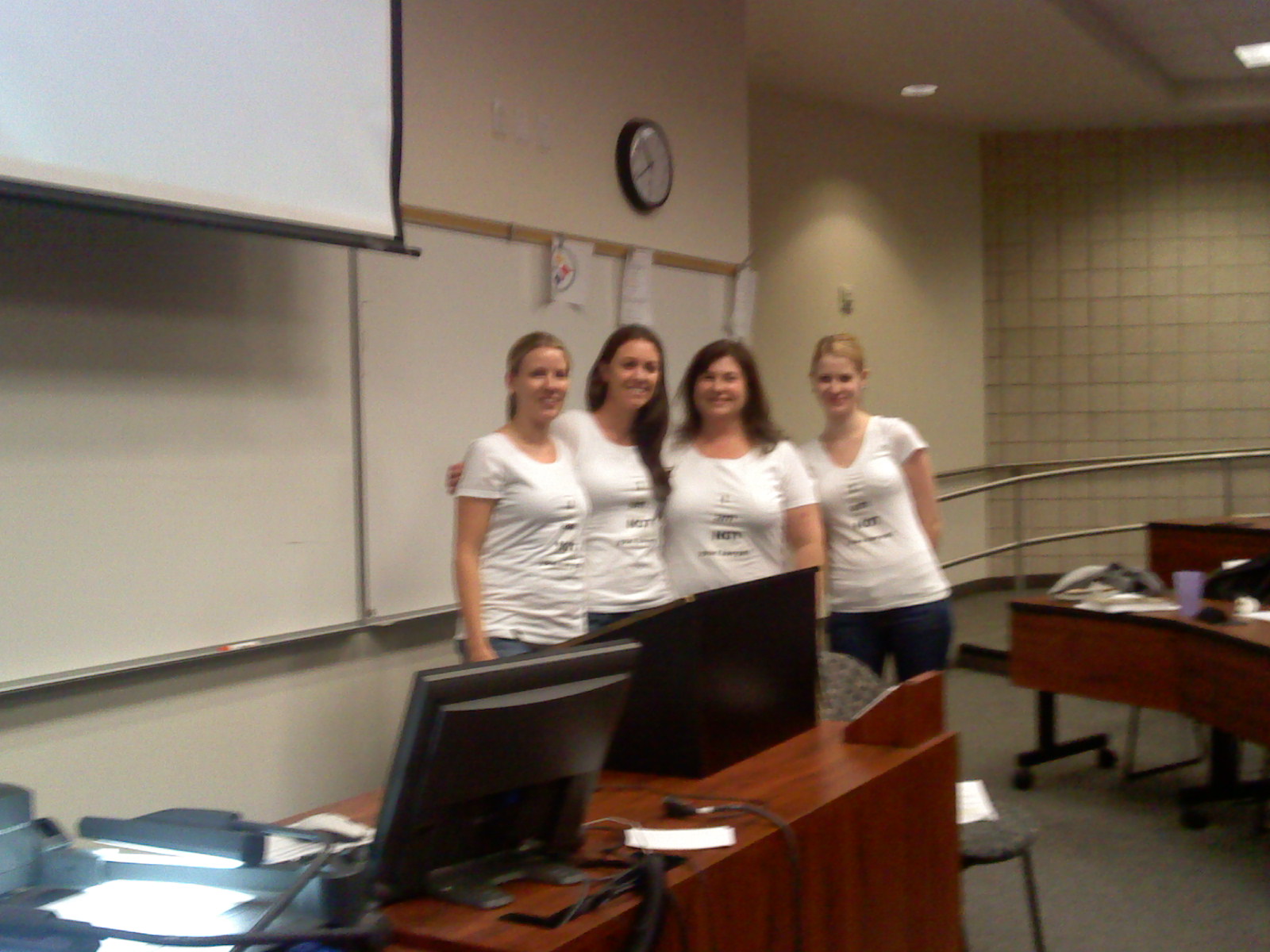
So: we've covered in class the notion that whether someone is a client depends on whether that person reasonably believes that she is a client. I've joked before that lawyers should wear shirts that have "I am not your lawyer" on the front and "This is not legal advice" on the back.
But I never expected one of the law firms to take me so literally:


Meet Kristin Gifford, Cheryl Grames, Anna Clark, and Chelsey Bosworth. I expect that they will add entrepreneurship to their legal skills after graduation.
Students have used movie clips, television shows, and games (including a rousing game of "Jeopardy," in which one of the categories was "What Would Rapoport Do?"--every day's presentation has been extremely good. What makes me particularly happy about each of the presentations is that the students are learning that they can teach themselves the law. That's a skill they'll need throughout their careers.
So: we've covered in class the notion that whether someone is a client depends on whether that person reasonably believes that she is a client. I've joked before that lawyers should wear shirts that have "I am not your lawyer" on the front and "This is not legal advice" on the back.
But I never expected one of the law firms to take me so literally:


Meet Kristin Gifford, Cheryl Grames, Anna Clark, and Chelsey Bosworth. I expect that they will add entrepreneurship to their legal skills after graduation.
Senin, 17 Januari 2011
Bravo to John Jay Douglass!
My former colleague, John Jay Douglass (here), passed along the news that he's retiring from law teaching. I have mixed feelings--happy that he and his wife, Papoose, can spend more time together, and sad that his career in academia's ending. As you can tell from even the brief description on the University of Houston Law Center's page above, he's educated not only law students but also district attorneys and other already-graduated professionals.
Here's to you, JJD! I think the world of you!
Here's to you, JJD! I think the world of you!
Sabtu, 30 Oktober 2010
Jumat, 15 Oktober 2010
Selasa, 05 Oktober 2010
Kamis, 16 September 2010
Rabu, 15 September 2010
Aspen will give you a taste of Law School Survival Manual by posting one free chapter.
And we think that the chapter's a doozy--it's on how to prepare for exams. See here for the link to Aspen1L.
Senin, 16 Agustus 2010
Larry Temkin changed my life, too.
One of my favorite professors from Rice University, Larry Temkin, now teaches at Rutgers. The Rutgers home page is featuring a salute to Larry (here) for the next two weeks. Although I hated to see Larry leave Rice, I was happy to see him courted by the best philosophy program in the country. (Oh, and Harvard courted him, too.)
What made Larry so good, in addition to his obvious desire to get his students excited about using their brains, was his ability to tease out--even from shy folks like me (and yes, I was shy!) a willingness to sink our teeth into difficult material. He didn't teach down to us, not even once. And like anyone else who's at the top of his game, his talent made us want to be better students. He was vibrant in class, engaging outside class, and downright inspiring. I can still see him bounding into class each day (and "bounding" is the correct word), ready to get the discussion started. Best of all, he put the lie to the fiction that really great teachers can't be great scholars as well. He was superb in both arenas, and he made everything look effortless, even though it wasn't effortless at all. Rutgers is very lucky to have him.
And while I'm thanking Larry for his remarkable contribution to my education, I should thank some other Rice profs as well. (I owe Bob Weisberg, Tom Jackson, and Jack Friedenthal, among others, thanks for my education at Stanford Law School, too, but that's a post for another time.)
Larry, along with folks like Baruch Brody (here), Dennis Huston (here), David Lane (here), Hank Hudspeth (here), and Harold Hyman (here), kept Rice's promise to provide an excellent undergraduate education.
Baruch Brody did give me a scare during my first semester, though. I'm from a small town in deep East Texas, and although my parents were from "up north" (New York and Toronto), I had never heard a rich Brooklyn accent before. I spent the first month of Dr. Brody's lectures wondering what he was saying and hoping that I didn't flunk his course. After I was able to translate his accent into "Texan," I figured out that I was getting what he was saying, after all.
Dennis Huston taught me that good professors could cuss up a blue streak without shifting our focus away from the material at hand. I took every course that he taught, and I'm still a member of his unofficial fan club.
David Lane turned me into a statistics geek, to our mutual amazement. He even let me take some graduate-level courses in statistics while I was an undergrad. Through him, too, I got to design my honors thesis on the effect of time of day on teaching performance, which is my own personal explanation for why my students fall asleep in class when I teach in the 3-4:30 slot.
Hank Hudspeth, who was kind enough to hire me for my first summer law job, was demanding without being demeaning, and he modeled how a true gentleman behaves. When I worked for his firm in the summer of (gasp!) 1983, I saw his commitment to professionalism first-hand and began to model my own professional life after his. I wish I could find his book, A Baker's Dozen of Torts, somewhere, because I lost my copy and I sure loved that book.
Harold Hyman scared me to death at Rice. He had an imposing presence and a booming voice, and his face reminded me of a real-life Sam the Eagle. He's also the first person I told about my getting into Stanford, and I remember him coming out from behind his desk to congratulate me. When Jeff & I came back to Houston in 2000, Harold and Ferne became our fast friends.
All of these folks contributed to my love of learning (which actually started with my mom and dad--there were more books in our house, and more time spent reading them, than I ever noticed in any of my friends' homes). I owe them big.
Jumat, 06 Agustus 2010
Shout-outs for new law professors
Thanks to my buddy Tim Zinnecker for mentioning the advice I've given to "newbie" law profs (see here), and kudos to my buddy Jeff Lipshaw (and his co-authors, Brandon Denning and Marcia McCormick) for their forthcoming ABA book, Becoming a Law Professor: A Candidate's Guide (see here). Brian Leiter mentioned this book on his blog today (see here).
I'd call today a good day for law professors.
I'd call today a good day for law professors.
Selasa, 22 Juni 2010
Do law school grades mean anything?
This morning's New York Times has a front-page article (here) about law schools raising their curves to make their students more attractive as job applicants. (Hat tip to Scott Unger and my dad.)
That change reminds me of Ellen Degeneres's routine about the difference between "upright" and "reclined" on airplane seats (here). We can call something whatever we want, but that doesn't change the nature of the thing. Even if the curve goes higher (say, a curve around a B+ instead of a B-), it's still an ordering of all of the people in the course.
Curved grades tell people how a given person did on a given exam on a given day, compared to the other people who took the exam that day. It's rather like George Carlin's old joke about partial scores in sports ("Notre Dame, 6"). It's information, but it's not complete information.
Employers use grades and the U.S. News rankings of schools because they believe that those two data points are approximations of how "good" the job candidates are, even though grades are actually not such a good shadow variable. Very few clients ask their lawyers to answer hypotheticals for three hours. There are a lot of the intangibles that make a good lawyer good, such as common sense, emotional intelligence, and teamwork, and grades don't necessarily correlate with those characteristics. I keep telling employers that taking a little more time on the front end (for example, by asking job candidates to talk about how they'd approach a particular situation) would pay off in the long run (retention of good candidates).
But until employers are willing to spend more time looking at more than mere transcripts, I can understand how tempting it is to raise a school's curve.
Why not go all the way, though? Some schools make it downright difficult to get anything but As. Playing with curves is just the start of something big--why not grade for mastery instead of for comparison purposes? Instead of curving grades, establish clear standards for what performance would constitute an A, what lesser performance would earn a B, etc. Then grades might actually be useful to the outside world.
In the meantime, folks might want to read Dan Keating's article on grades: Daniel Keating, Ten Myths About Law School Grading, 76 Wash. U. L.Q. 171 (1998). It's a fun read.
Update (6/25) (hat tip to my buddy Seymour Serebnick): see the NYT's letters to the editor about the original story here.
Langganan:
Postingan (Atom)