[Y]ou refer to St. Thomas Law School as having done “the right thing and ‘fessed up when it discovered that it had been misrepresenting its placement data.” This is an important paper on an important topic, and I’m glad you’re tackling it head on. I fear, though, that this line may lead readers to lump St. Thomas in with other law schools that have shown a pattern of deliberate misrepresentation. Our oversight was a one-time occurrence that resulted from an erroneous entry of data.I'm happy to help Dean Vischer clarify his school's role. There's a huge difference between making a mistake and engaging in a pattern of deception.
Specifically, on line 169 of our Class of 2010 U.S. News Employment data report, the number of graduates known to be employed at graduation was correctly listed as 51 graduates (or 32.9% of our 155 total number of 2010 graduates). Unfortunately, on line 164 of the report, we incorrectly listed 125 graduates (or 80.6%) as employed at graduation. U.S. News listed that incorrect number in its law school rankings. We immediately contacted U.S. News to alert them to the error. The nine month graduation rate of 86.5% was correct in the rankings.
We did make a one-time mistake, and we paid the price by being unranked for a year. I’m hoping to avoid leaving the impression that we are another example of law schools trying to fudge the truth over a period of years.
Tampilkan postingan dengan label Enron. Tampilkan semua postingan
Tampilkan postingan dengan label Enron. Tampilkan semua postingan
Rabu, 15 Mei 2013
Update on my Gonzaga piece on law schools, lying, and Enron.
After I published this piece, Robert K. Vischer, the dean of the University of St. Thomas Law School (Minnesota), gently suggested that I might want to clarify St. Thomas's restatement of its employment data:

Jumat, 02 Maret 2012
The news article that a lawyer does not want to see when she's having her morning coffee.
See here. Shades of Arthur Andersen's shredding scandal. Having a rogue manager (assuming that's what happened) shred documents, counter to attorney instructions, is one of a lawyer's worst nightmares.
Sabtu, 10 Desember 2011
Rabu, 07 Desember 2011
We don't learn. Maybe we can't.
Today's WSJ article about the Olympus scandal (here) proves that we haven't learned anything, really, about avoiding corporate scandals. Why? Here are some possibilities:
__ People are inherently evil.
Nah. There are good people, and there are evil people. But most of us fall somewhere in the middle, and it's the situations that we find ourselves in that will push us toward either good behavior or bad behavior. So I have to reject that gloomy "people are just evil" explanation.
__ Smart people think that they can fix mistakes by covering them up.
Yep. Ever since Watergate, we've known that the mistakes aren't nearly as bad for us as the cover-ups are, but we keep making the same "let's cover things up" mistake. Heck, Vegas and other gaming centers are based on the idea that folks will chase their losses until they win again (and they usually don't win again). But smart people keep thinking that they can outsmart the system, and that they won't get caught. Will we learn from our mistakes?
Based on the empirical data, I'm thinking that we won't. (But that doesn't mean that we shouldn't try.)
Kamis, 01 Desember 2011
Senin, 28 November 2011
Enron in retrospective.
BBC Radio 5 Live's Wake Up To Money asked me a bit about Enron, 10 years later (interview starts around minute 27:30), or click here.
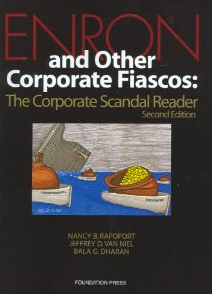
My Dad and my buddy Gus Schill pointed me to the Houston Chronicle's Enron retrospective: see here, here, and Fuel Fix's compilation, here. Some of my takes are here, here (Colin Marks and I wrote this one), here, and here. And the books that Bala Dharan, Jeff (yep, my Jeff) Van Niel, and I did: here and here.
Short version of my take on things, 10 years later? Two things: those who do not learn from history are doomed to repeat it, and humans don't seem to be able to learn from history, at least where their own cognition is concerned.
Kamis, 27 Oktober 2011
Enron rap--a new classic.
Hat tip to Jackie Benson (who happens to be exceptionally smart, talented, and fun to know) and Above the Law. You can listen to it here. Click on Daniel Sokol's blog (here) for the text of the full rap.
Senin, 29 Agustus 2011
Rabu, 03 Agustus 2011
(update) WONDERFUL column on Enron's former directors.
See the Deal Professor's column in today's New York Times (here).
UPDATE (or why I shouldn't monitor my blog before 6:15 a.m.)--my buddy George posted a great comment, which I accidentally deleted, so here it is:
UPDATE (or why I shouldn't monitor my blog before 6:15 a.m.)--my buddy George posted a great comment, which I accidentally deleted, so here it is:
While I do not think all of the folks mentioned in the article are as pure as the driven snow, there is a thinly veiled assumption that they knew what was going on when bad things were happening and turned a blind eye. I think it is premature to indict them in the media when they were probably lied to like the unlucky investors in those companies (or would any of you like some of our Lehman Brothers stock?).Me: George, I'm sure that they were lied to. There's no way that they weren't. The question that I have (and one that I don't know how to answer) is how boards can pierce through any lies that their managers throw their way, especially when they assume that their managers are the good guys. If you post another comment, I promise to have had coffee and won't accidentally delete it!
Rabu, 06 April 2011
Minggu, 27 Februari 2011
A tale of two abuses.
OK, look at Joe Nocera's column in yesterday's New York Times (here) ("Biggest Fish Face Little Risk of Being Caught"), and then look at Gretchen Morgenson's column today (here) ("Waiting Seven Years for Two Answers"). My own conclusion is that there's no downside risk to overreaching in ways that hurt consumers. (Mozilo, no jail time? Wells Fargo Bank, with three different stories about the reasons behind its inability to demonstrate proof of holding a note on a house?) Of course things aren't going to change. Not until there's some real, personal, honest-to-goodness, scary consequences for executives who tolerate obscenely bad behavior. And I'm not counting on there being any, unless Elizabeth Warren's Bureau of Consumer Financial Protection actually figures out a way to get the incentives for (1) punishing bad behavior and (2) allowing innovation right. If anyone can, she can; but I'm not sure it's possible.
And I come back to the same question, time and again: where are the boards? How do those independent directors get the information that they need to ensure that their officers are behaving appropriately? And how do those directors fight the urge to get along by playing along?
Minggu, 20 Februari 2011
Heroes don't like to be called "whistle-blowers."
In today's New York Times Gretchen Morgenson column, she describes the travails and eventually victory of former Countrywide exec Michael Winston (here). Winston sounds like exactly the sort of stand-up guy I'd want running my company (if I had one). Like other heroes who have called shenanigans on their company's blatant misdeeds, he probably would prefer just to say he did his job. Thanks to my former jobs, I've met a few other heroes of this ilk. (See here, here, and -- although I didn't meet her in person, she did agree to let us excerpt a few of her bio chapters in our second Enron book -- here.) Except for Cynthia Cooper's publicist, who does identify her as a whistle-blower, most of these heroes equate "whistle-blowing" with "snitching." They just call what they did "being ethical." And that's why they're my heroes.
Kamis, 30 Desember 2010
Yep. I was a chump.
See here. This TaxProf Blog post points out how much creative accounting folderol goes into reporting employment stats of law schools to U.S. News.
As I've said before (see here), lying on these questionnaires isn't much different from the "earnings management" that went on at Enron and the other like-minded companies. Refusing to lie puts schools at a huge disadvantage, but lying just results in a race to the bottom in accuracy while pursuing a race to the top in "100% employed" reports.
Minggu, 12 Desember 2010
Best lesson taken from Madoff fiasco.
See Michael Kubin's opinion piece in the New York Times (here).
Kamis, 24 Juni 2010
Rabu, 26 Mei 2010
We've learned nothing from Enron.
Kamis, 06 Mei 2010
Rabu, 14 April 2010
A nice update about Nancy Temple's career
Legal Ethics Forum has posted an update on Nancy Temple's career (here). Nancy Temple was the Arthur Andersen lawyer whom the jurors in the obstruction of justice case blamed (wrongly, I think) as the "corrupt persuader." I remember how several of my in-house counsel friends shuddered when they read Ms. Temple's email warning David Duncan not to call a recurring expense a non-recurring one in a press release. That's a normal email for a lawyer to send, but I think that the jury felt as if Ms. Temple was trying to do something other than clear up an accounting classification. (I also think that the public's distaste for lawyers generally contributed to the verdict.)
I'm very glad that Ms. Temple's doing well. I think she had gotten a raw deal.
Senin, 05 April 2010
On the other hand, the secondary market for our SECOND edition of the Enron book is doing surprisingly well.

Sabtu, 03 April 2010

Langganan:
Postingan (Atom)