On another blog (Law School Survival Manual), I've spent a bit of time ruminating over just what in Larry Mitchell's op-ed rubbed me the wrong way. (See here.) Other folks are saying the same thing, often in better ways (take a gander at the updates to my post for two such examples, and to the postings on Inside the Law School Scam (starting here).
I guess what frustrates me most is the sense that decanal groupthink is trying to wish away a lot of the problems that face legal education. There were many, many kudos to the Mitchell op-ed on one of the deans' listservs. If those kudos had been from the very top law schools, I'd have understood. Law degrees from Harvard, Yale, Stanford, and other such schools are likely to be exceptionally good investments. (After all, I benefit greatly from my degree from Stanford.*)
But when good, but not elite, schools are making their case for law school being a good investment, they can't just trot out the "we train you to think!" and "law is a lifetime career!" arguments. I don't think that the first of those arguments applies just to law schools (pretty much any good education will train someone to think well). And I don't think that the "law is a lifetime career" theory works when a law graduate can't get a first law job within a reasonable time. The "you can use a law degree in other careers" argument is true, of course, but just because someone can use a legal education in other fields doesn't mean that spending six figures to get that degree is always a good idea.
I'm as proud of legal education as every other law dean is,** but I want students to enter law school with their eyes open. (I also want law schools to provide applicants with accurate data so that they can make good choices about whether to attend law school.)
Data + realistic expectations = good choices.
Assertions + wishful thinking = a disaster in the making.
* Although, to be fair, my degree from Rice is nearer and dearer to my heart, but that's probably true of most folks' feelings about their undergraduate degrees.
** Even though I'm just an interim dean.
Tampilkan postingan dengan label Boyd School of Law. Tampilkan semua postingan
Tampilkan postingan dengan label Boyd School of Law. Tampilkan semua postingan
Minggu, 02 Desember 2012

Selasa, 16 Oktober 2012
Why the deanship at the Boyd School of Law is a plum deanship--and why I'm not a candidate.
We have just posted our ad inviting nominations and applications for the deanship here at Boyd Law (see here for ad). I am having a marvelous time as Interim Dean, and here are some of the reasons why:
I also want to spend more time with my family. I know: that's a hoary old saying, but it's true in this case. I don't have nearly enough time with my husband and my dad. I don't have nearly enough time to devote to my ballroom dancing addiction. I find myself getting forgetful and misplacing more things than usual, and I'm pretty sure that I can attribute that forgetfulness to the stress of being in this office. The stress is "good" stress, in that I'm happy to serve as interim dean, but it's stress just the same.
So, although it is an immense honor to be our interim dean ("iDean" to some), and although I am really enjoying my time in this office, I will look forward to helping our next "real" dean through a transition period and then returning to my colleagues on the 4th floor. In the meantime, though, I'm happy to answer any questions that anyone might have about Boyd Law or about the deanship.
Smart, creative servant-leaders--please apply!
- We really are a collegial place. I've worked at collegial places before (hello, Ohio State!), and I can still say that, of all of the places I've worked, none has been as overwhelmingly collegial as Boyd Law. One of my favorite things about our school is that, when someone does something really good, that information gets on our listserv and is invariably seconded (and thirded) with "congratulations!" That's the sign of a school with a "we're a team" mentality.
- We really are a productive place. When I walk down the hallways, I see people working--and working hard. Folks are excited about what they're doing, and they're happy to talk about their progress on their various projects. We have a very engaged faculty and staff.
- The depth and breadth of the talent running the school is spectacular. I've had the pleasure of working primarily with the administrative assistants in the faculty area for the first five years that I was here, and now I also get to work with the folks in the various administrative suites. The only bad thing that I can say about them (both the folks in the faculty area and the folks in the administrative suites) is that they're workaholics. (Getting emails early in the morning and late at night to follow up on things or share ideas is the dead giveaway that they're workaholics.) They're smart. They're talented. They care deeply about the success of the school and of all the people in our school. I'll miss working with them when I return to the faculty--but, luckily, I'll have the pleasure of still working directly with Nettie Mann and her team.
- There is laughter here, and it's the good kind of laughter, not the "we're making fun of you" kind of laughter. When you work with very busy and creative people, there are moments in the day when you can share a good belly-laugh. That's been true from the moment I arrived here in 2007. We take our jobs seriously, but we're not stuffy people.
- Our program's in good shape. We're fine financially; we enjoy a good reputation in the community; our curriculum is adapting to changing needs. Whoever gets this deanship will be in the enviable position of working as part of a team on a school that's already very good and is ready to get even better.
I also want to spend more time with my family. I know: that's a hoary old saying, but it's true in this case. I don't have nearly enough time with my husband and my dad. I don't have nearly enough time to devote to my ballroom dancing addiction. I find myself getting forgetful and misplacing more things than usual, and I'm pretty sure that I can attribute that forgetfulness to the stress of being in this office. The stress is "good" stress, in that I'm happy to serve as interim dean, but it's stress just the same.
So, although it is an immense honor to be our interim dean ("iDean" to some), and although I am really enjoying my time in this office, I will look forward to helping our next "real" dean through a transition period and then returning to my colleagues on the 4th floor. In the meantime, though, I'm happy to answer any questions that anyone might have about Boyd Law or about the deanship.
Smart, creative servant-leaders--please apply!
Selasa, 17 Juli 2012
It's nice to be recognized: UNLV (Boyd) Law is 45th in most-cited study.
See here. Hat tip to TaxProf Blog.
Rabu, 03 Agustus 2011
Best prep for becoming a first-year law student.
See here. One of our new first-years has been helping people who can't afford lawyers to understand the system. Here's what the story says about him:
Berchtold is particularly enthusiastic about a staff assistant designated to handle customers who have received home mortgage default notices and are thinking about opting for the Foreclosure Mediation Program run by the Nevada Supreme Court. That position is filled by Adam Tully, who will enter UNLV’s Boyd Law School this fall.Welcome, Adam--I can't wait to see the kind of good you'll do when you get your J.D., pass the bar, and can help people parse the system in your role as a lawyer. BRAVO!
Minggu, 26 Juni 2011
Fun with professional responsibility.
One of my favorite students at Boyd, Jason Lather, has alerted me to this story about a newbie lawyer who took on way, way too much: here. Fascinating. Thanks, Jason!
Kamis, 14 April 2011
Jumat, 08 April 2011
An open letter to Nevada's governor and legislature and to the Board of Regents.
I was hoping to be able to speak at today's special meeting of the Board of Regents, during the public comment session, but I had to leave to teach my class later this morning. Here's what I would have said:
You have a very difficult task in front of you, with Nevada's budget situation getting worse every day, and I don't envy you. I did want to give you a feel for how some of the research done at the Boyd School of Law contributes directly to Nevadans and to the country as a whole.
First, some bragging about our students. I'm one of the faculty advisors to the Gaming Law Journal and the Nevada Law Journal (lexis.com). Those two magazines publish both faculty research (not just our faculty's research, but the research done by scholars elsewhere as well) and student research. The GLJ is still rather young, but the NLJ's research has been cited by courts here in Nevada, including the Nevada Supreme Court, and by other courts. One of the country's most famous and well-regarded judges, the Hon. Richard Posner of the United States Court of Appeals for the Seventh Circuit, has cited the NLJ more than once. By publishing useful and high quality research, our students are providing courts with the means to make good decisions.
Second, the research that I'm doing in terms of bankruptcy ethics (the behavior of bankruptcy lawyers) is part of my overall research agenda, which is geared to supporting the behavior of good lawyers and to getting bad lawyers out of the legal system. It's not every day that I see, on the front page of the Review-Journal, an article on the reasonableness of attorney fees in bankruptcy cases (here). Part of my own research involves developing ways to help bankruptcy courts determine whether attorneys fees are reasonable. Reasonableness is a balancing act. The fees must compensate good lawyers and other professionals for their work in helping a debtor reorganize, but they can't carry a lot of redundancies and inefficiency. Dollars saved by reviewing fees for reasonableness can inure to the benefit of unsecured creditors, who get paid after the professionals are compensated for their work. (Distribution of payments in bankruptcy is more complicated than this description, but this one will suffice here.) Based on my work in this area, I've been asked twice to assist a bankruptcy court in Fort Worth in reviewing fees of two large chapter 11 cases, and I'm currently assisting the bankruptcy court here in Nevada in a similar capacity. The Boyd students and graduates who help me in this work are learning about how large chapter 11 cases work, and about how lawyers and other professionals fit into that process. It's good hands-on learning that will serve them well in their careers.
My research in bankruptcy ethics has also enabled me to help out the Office of the U.S. Trustee (which is part of the Department of Justice) in ferreting out lawyers who may be violating the ethics rules about the unauthorized practice of law. My ability to be useful in such matters is directly tied to my research. In my view, teaching, research, and service are inextricably linked.
My research about legal education has also informed my teaching. I've been hearing for some time that law students are trained to write memoranda--not to advise clients. (Our clinic students, of course, get the training that comes with dealing with live clients.) That's one of the reasons that my upper-level Professional Responsibility students are doing presentations in class. It's also why those presentations require teamwork. Teaching students legal ethics in a way that forces them to construe statutes (the Model Rules of Professional Conduct and figure out how to convey information to people who don't already know it is part of their legal training. Again, it's a mix of teaching and research that lets me give students the opportunity to practice some of the skills that they'll need after graduation.
While I was waiting in line to speak this morning, I heard numerous examples of what the budget cuts will do to the educational system in Nevada. I couldn't help thinking about what a success story Boyd is. We're a young law school, and yet we're able to turn law students into skilled and ethical lawyers. We're doing a very good job on what amounts to a shoestring budget: we're understaffed, our students' tuition dollars are stretched to the breaking point, and we still do everything that a good law school must do in order to be relevant to legal education and to the public.
Several of us have had many opportunities to go elsewhere. I'm choosing to stay because I believe in the strength of our school, even in the face of this budget crisis, and because I value what my colleagues are doing to keep our school's trajectory moving in the right direction.
As you consider how to deal with the budget crisis, I would urge you to focus not just on how (and how much) we at UNLV teach but also on how our research benefits the state and the country (and, for some of my colleagues, the international community). Investing in education here in Nevada is crucial if our state is to survive. We can and should invest wisely--with all that "investing wisely" means-- but we have to invest.
You have a very difficult task in front of you, with Nevada's budget situation getting worse every day, and I don't envy you. I did want to give you a feel for how some of the research done at the Boyd School of Law contributes directly to Nevadans and to the country as a whole.
First, some bragging about our students. I'm one of the faculty advisors to the Gaming Law Journal and the Nevada Law Journal (lexis.com). Those two magazines publish both faculty research (not just our faculty's research, but the research done by scholars elsewhere as well) and student research. The GLJ is still rather young, but the NLJ's research has been cited by courts here in Nevada, including the Nevada Supreme Court, and by other courts. One of the country's most famous and well-regarded judges, the Hon. Richard Posner of the United States Court of Appeals for the Seventh Circuit, has cited the NLJ more than once. By publishing useful and high quality research, our students are providing courts with the means to make good decisions.
Second, the research that I'm doing in terms of bankruptcy ethics (the behavior of bankruptcy lawyers) is part of my overall research agenda, which is geared to supporting the behavior of good lawyers and to getting bad lawyers out of the legal system. It's not every day that I see, on the front page of the Review-Journal, an article on the reasonableness of attorney fees in bankruptcy cases (here). Part of my own research involves developing ways to help bankruptcy courts determine whether attorneys fees are reasonable. Reasonableness is a balancing act. The fees must compensate good lawyers and other professionals for their work in helping a debtor reorganize, but they can't carry a lot of redundancies and inefficiency. Dollars saved by reviewing fees for reasonableness can inure to the benefit of unsecured creditors, who get paid after the professionals are compensated for their work. (Distribution of payments in bankruptcy is more complicated than this description, but this one will suffice here.) Based on my work in this area, I've been asked twice to assist a bankruptcy court in Fort Worth in reviewing fees of two large chapter 11 cases, and I'm currently assisting the bankruptcy court here in Nevada in a similar capacity. The Boyd students and graduates who help me in this work are learning about how large chapter 11 cases work, and about how lawyers and other professionals fit into that process. It's good hands-on learning that will serve them well in their careers.
My research in bankruptcy ethics has also enabled me to help out the Office of the U.S. Trustee (which is part of the Department of Justice) in ferreting out lawyers who may be violating the ethics rules about the unauthorized practice of law. My ability to be useful in such matters is directly tied to my research. In my view, teaching, research, and service are inextricably linked.
My research about legal education has also informed my teaching. I've been hearing for some time that law students are trained to write memoranda--not to advise clients. (Our clinic students, of course, get the training that comes with dealing with live clients.) That's one of the reasons that my upper-level Professional Responsibility students are doing presentations in class. It's also why those presentations require teamwork. Teaching students legal ethics in a way that forces them to construe statutes (the Model Rules of Professional Conduct and figure out how to convey information to people who don't already know it is part of their legal training. Again, it's a mix of teaching and research that lets me give students the opportunity to practice some of the skills that they'll need after graduation.
While I was waiting in line to speak this morning, I heard numerous examples of what the budget cuts will do to the educational system in Nevada. I couldn't help thinking about what a success story Boyd is. We're a young law school, and yet we're able to turn law students into skilled and ethical lawyers. We're doing a very good job on what amounts to a shoestring budget: we're understaffed, our students' tuition dollars are stretched to the breaking point, and we still do everything that a good law school must do in order to be relevant to legal education and to the public.
Several of us have had many opportunities to go elsewhere. I'm choosing to stay because I believe in the strength of our school, even in the face of this budget crisis, and because I value what my colleagues are doing to keep our school's trajectory moving in the right direction.
As you consider how to deal with the budget crisis, I would urge you to focus not just on how (and how much) we at UNLV teach but also on how our research benefits the state and the country (and, for some of my colleagues, the international community). Investing in education here in Nevada is crucial if our state is to survive. We can and should invest wisely--with all that "investing wisely" means-- but we have to invest.
Rabu, 06 April 2011
Sabtu, 26 Maret 2011
Thanks, SBLI & Georgia State University College of Law!
Having finished this week's visit to Georgia State's law school, courtesy of the Southeastern Bankruptcy Law Institute, I just want to say thanks: thanks to SBLI for funding this program and for choosing me as this year's visiting professor; thanks to the great folks at Georgia State who made me feel so at home; and thanks to the Boyd School of Law for being so nice about my taking a week away during the semester. My own spring semester Professional Responsibility students get my special thanks for being willing to do class via Skype. They did a superb job yesterday.
Minggu, 13 Maret 2011
Greetings from a non-mediocre institution.
It's no secret that Nevada's budget is in horrible shape, and that problem is not likely to improve in the near future. We are living in interesting times, with all that that phrase entails.
But I took umbrage when I read this piece in the National Law Journal (here) about what the budget cuts might do to our school. (Thanks, though, to all of my buddies who passed along the article to me.) I haven't seen the summary to which the article referred ("A summary accompanying Smatresk's letter notes that the plan would require significant tuition increases. 'These additional increases will undermine the law school's successful formula and render it a mediocre institution,' the summary reads.") Whoever wrote that summary was, I'm guessing, trying to communicate that the burden for keeping us from drastic cuts will fall on our students, who will have to pay significantly more in tuition if the state can't figure out a way to help subsidize their education. "Mediocre," though, doesn't describe us now and won't describe us later.
So far this year, we've hired:
Linda Berger, Mercer School of Law. Seven edited volumes on legal writing, rhetoric, and the burgeoning field of metaphor & narrative. 11 articles. Founding editor of J. ALWD.
Ruben Garcia, Cal Western. Labor law expert, former Hastie Fellow, VAP at UC Davis. 16 articles, one book in progress (NYU Press).
Ian Bartrum, Drake University Law School. Ribicoff Fellow in Law at Yale Law School, VAP at Vermont Law School. 12 publications on constitutional interpretation and theory.
Michael Kagan, entry-level hire. Experienced refugee expert in the Middle East and North Africa with stints at Asylum Access, Africa Middle East Refugee Assistance (AMERA), Negotiations Support Unit, Frontiers Association, Musa'adeen Refugee Project, and Egyptian Organization for Human Rights, Amnesty International. 13 articles and book chapters. Teaching experience at American University in Cairo and Tel Aviv University Faculty of Law.
Year-long visitor:
Lisa Bingham, Indiana University School of Public and Environmental Affairs. Visitor at Berkeley, Hastings, Maxwell School of Syracuse, and Aberdeen School of Law. Fulbright fellow in Sweden. Industrial relations, ADR, and Labor Law expert with over 60 articles in peer-reviewed and law journals, over 25 book chapters, and 5 book reviews. Expert in labor negotiations and mediation.
That's on top of the folks we've hired over the last few years, each of them gems. Take a gander at our faculty home page (here).
Ultimately, Nevada has to decide if having an educated workforce is important and, if so, how it might help to encourage and maintain such a workforce. Not even 12 years ago (we're not even old enough to have a bar mitzvah yet), Boyd was a baby law school, formed out of Nevada's desire to keep its budding law students from having to leave the state to get a law degree. There has to be some happy medium between the low/no taxes stance we have now and the too-burdensome taxes that too many states have. In a competitive world, where employers can outsource almost anything to very smart people in other countries, we have to have smart, innovative people on the ground here in Nevada. That takes education, for starters.
Mediocre law school? Nope. We have a good law school, with engaged faculty and staff members and dedicated students. It's a warm community--one of the best I've ever enjoyed. I have confidence that we'll be able to figure out a way to go forward without losing our momentum. Whether the state is able to figure out a way to get its momentum back is another issue entirely.
But I took umbrage when I read this piece in the National Law Journal (here) about what the budget cuts might do to our school. (Thanks, though, to all of my buddies who passed along the article to me.) I haven't seen the summary to which the article referred ("A summary accompanying Smatresk's letter notes that the plan would require significant tuition increases. 'These additional increases will undermine the law school's successful formula and render it a mediocre institution,' the summary reads.") Whoever wrote that summary was, I'm guessing, trying to communicate that the burden for keeping us from drastic cuts will fall on our students, who will have to pay significantly more in tuition if the state can't figure out a way to help subsidize their education. "Mediocre," though, doesn't describe us now and won't describe us later.
So far this year, we've hired:
Linda Berger, Mercer School of Law. Seven edited volumes on legal writing, rhetoric, and the burgeoning field of metaphor & narrative. 11 articles. Founding editor of J. ALWD.
Ruben Garcia, Cal Western. Labor law expert, former Hastie Fellow, VAP at UC Davis. 16 articles, one book in progress (NYU Press).
Ian Bartrum, Drake University Law School. Ribicoff Fellow in Law at Yale Law School, VAP at Vermont Law School. 12 publications on constitutional interpretation and theory.
Michael Kagan, entry-level hire. Experienced refugee expert in the Middle East and North Africa with stints at Asylum Access, Africa Middle East Refugee Assistance (AMERA), Negotiations Support Unit, Frontiers Association, Musa'adeen Refugee Project, and Egyptian Organization for Human Rights, Amnesty International. 13 articles and book chapters. Teaching experience at American University in Cairo and Tel Aviv University Faculty of Law.
Year-long visitor:
Lisa Bingham, Indiana University School of Public and Environmental Affairs. Visitor at Berkeley, Hastings, Maxwell School of Syracuse, and Aberdeen School of Law. Fulbright fellow in Sweden. Industrial relations, ADR, and Labor Law expert with over 60 articles in peer-reviewed and law journals, over 25 book chapters, and 5 book reviews. Expert in labor negotiations and mediation.
That's on top of the folks we've hired over the last few years, each of them gems. Take a gander at our faculty home page (here).
Ultimately, Nevada has to decide if having an educated workforce is important and, if so, how it might help to encourage and maintain such a workforce. Not even 12 years ago (we're not even old enough to have a bar mitzvah yet), Boyd was a baby law school, formed out of Nevada's desire to keep its budding law students from having to leave the state to get a law degree. There has to be some happy medium between the low/no taxes stance we have now and the too-burdensome taxes that too many states have. In a competitive world, where employers can outsource almost anything to very smart people in other countries, we have to have smart, innovative people on the ground here in Nevada. That takes education, for starters.
Mediocre law school? Nope. We have a good law school, with engaged faculty and staff members and dedicated students. It's a warm community--one of the best I've ever enjoyed. I have confidence that we'll be able to figure out a way to go forward without losing our momentum. Whether the state is able to figure out a way to get its momentum back is another issue entirely.
Senin, 07 Februari 2011
Bragging on my Professional Responsibility students.
So I'm teaching Professional Responsibility again this semester, and I'm doing it primarily through "law firm" presentations: groups of law students who have to present the day's material in a way that provides coverage and encourages class participation.
Students have used movie clips, television shows, and games (including a rousing game of "Jeopardy," in which one of the categories was "What Would Rapoport Do?"--every day's presentation has been extremely good. What makes me particularly happy about each of the presentations is that the students are learning that they can teach themselves the law. That's a skill they'll need throughout their careers.
So: we've covered in class the notion that whether someone is a client depends on whether that person reasonably believes that she is a client. I've joked before that lawyers should wear shirts that have "I am not your lawyer" on the front and "This is not legal advice" on the back.
But I never expected one of the law firms to take me so literally:


Meet Kristin Gifford, Cheryl Grames, Anna Clark, and Chelsey Bosworth. I expect that they will add entrepreneurship to their legal skills after graduation.
Students have used movie clips, television shows, and games (including a rousing game of "Jeopardy," in which one of the categories was "What Would Rapoport Do?"--every day's presentation has been extremely good. What makes me particularly happy about each of the presentations is that the students are learning that they can teach themselves the law. That's a skill they'll need throughout their careers.
So: we've covered in class the notion that whether someone is a client depends on whether that person reasonably believes that she is a client. I've joked before that lawyers should wear shirts that have "I am not your lawyer" on the front and "This is not legal advice" on the back.
But I never expected one of the law firms to take me so literally:
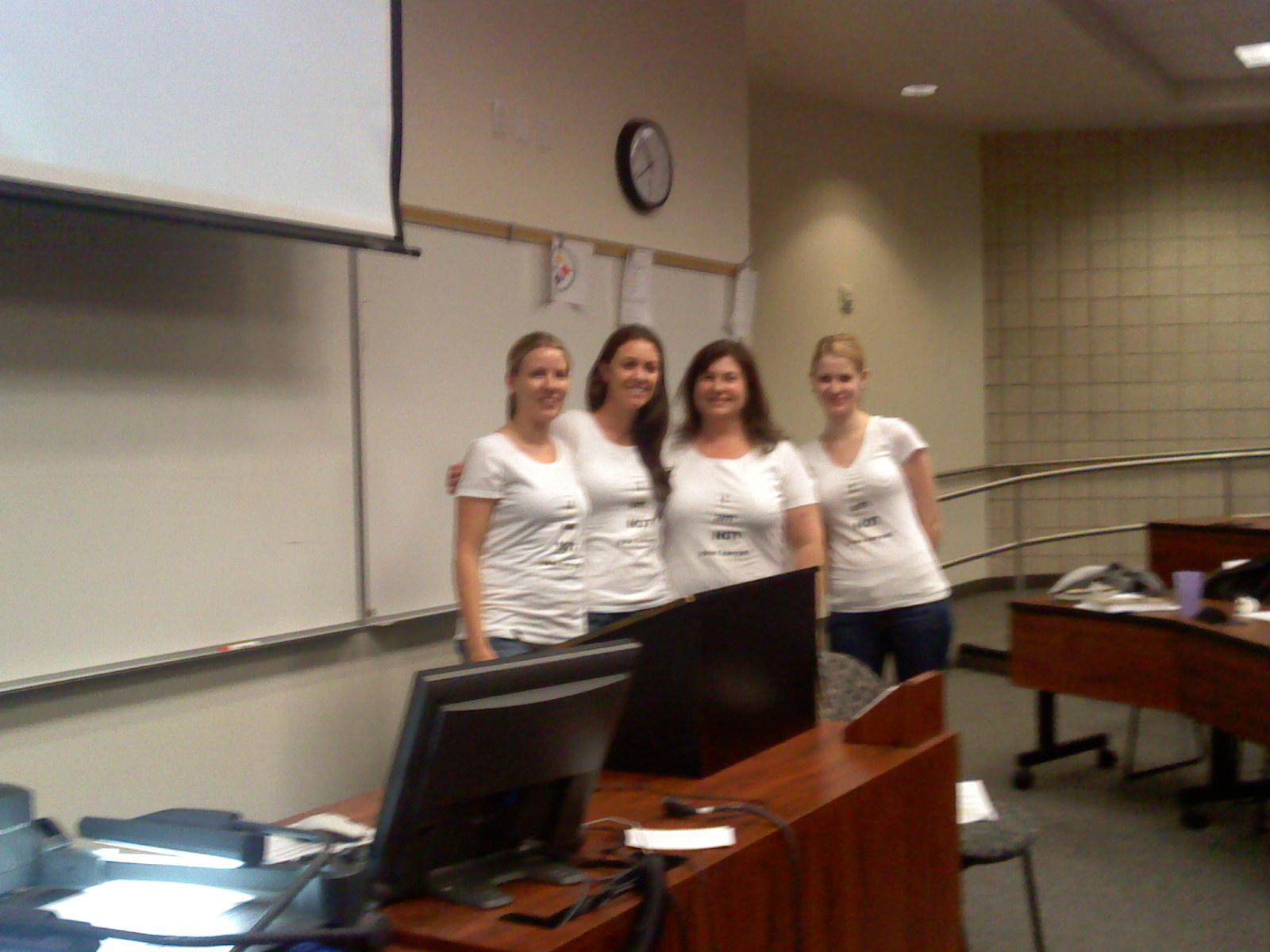


Meet Kristin Gifford, Cheryl Grames, Anna Clark, and Chelsey Bosworth. I expect that they will add entrepreneurship to their legal skills after graduation.
Selasa, 05 Oktober 2010
Senin, 13 September 2010
A nice feather in Boyd School of Law's cap.
One of the things I love about Boyd is how engaged our faculty is in research. Now Brian Leiter has a post that recognizes how we're doing (see here). It's also nice to see Ohio State in that list--not at all surprising, but nice nonetheless.
Thanks, Brian!
Thanks, Brian!
Jumat, 16 April 2010
A new social networking "first" for me....
So I'm taking a break from work by checking my Facebook page, and one of our Boyd law students IMs me to ask me to supervise his summer research paper. I've got to say that's the fastest I've ever been asked (or have answered) such a request.
And it proves that our students are creative about finding ways to reach us.
And it proves that our students are creative about finding ways to reach us.
Kamis, 04 Maret 2010
Wrong. Wrong on so many levels....
Hat tip to UNLV's own Matthew Stafford for pointing me to this Above the Law post (here).
I count 7 independent ethically (and grammatically) challenged errors in this one business card. Anyone care to list them?
I count 7 independent ethically (and grammatically) challenged errors in this one business card. Anyone care to list them?
Senin, 22 Februari 2010
Newsflash: small, newly established law schools not in National Law Journal's top 25
Thanks to my home Google page, I read TaxProf Blog regularly, so I clicked on the links (see here and here) to the National Law Journal's Law School Report (here). The basic methodology: "[NLJ has] ranked the top 50 law schools by the percentage of 2009 juris doctor graduates who snagged jobs at NLJ 250 firms by Sept. 30, 2009."
What I like: the ranking at least gives users some useful information about the link between going to a particular school and how many of that school's grads go to BigLaw; my alma mater (Stanford) did well, even though many older grads (25th reunion this year!) are BigLaw refugees; and there are thoughtful articles that accompany the report (see Emily Spieler's thoughts here).
The only drawback is that some newer schools (think Boyd) won't make the cut for a while, if ever: we're still new-ish, as law schools go (in two more years, the school could have a Bar Mitzvah), and we don't have the benefit of having a plethora of branch offices of BigLaw firms in Nevada, although we do place graduates in many other states.
All in all, though, the Law School Report makes for juicy reading.
What I like: the ranking at least gives users some useful information about the link between going to a particular school and how many of that school's grads go to BigLaw; my alma mater (Stanford) did well, even though many older grads (25th reunion this year!) are BigLaw refugees; and there are thoughtful articles that accompany the report (see Emily Spieler's thoughts here).
The only drawback is that some newer schools (think Boyd) won't make the cut for a while, if ever: we're still new-ish, as law schools go (in two more years, the school could have a Bar Mitzvah), and we don't have the benefit of having a plethora of branch offices of BigLaw firms in Nevada, although we do place graduates in many other states.
All in all, though, the Law School Report makes for juicy reading.
Minggu, 14 Februari 2010
Does higher education have some explaining to do?
I was reading the op-ed page this morning, and I came across Glenn Cook's A Few Questions for Carson City (here). Among the questions that he asked, two in particular caught my eye:
In my mind, the mission of community colleges is access. Excellent community colleges give their students the ability to build a solid foundation for the careers that they choose. Take a look at Nevada State College's mission statement (here): "Through student-centered learning, Nevada State College emphasizes and values: exceptional teaching, mentoring, advisement;* scholarship; career and personal advancement; continuing education; and service to our community."
The mission of research universities is discovery. Excellent research universities don't just disseminate already-discovered knowledge well; they build upon that knowledge with new discoveries. And these discoveries aren't the same as the important discoveries that industry produces. Industry-funded discoveries are intended, by definition, to develop industry objectives and bottom lines. University-based discovery advances our knowledge in the arts and sciences, and that discovery activity makes our teaching better. We can talk with our students about what our discoveries mean for our fields, and we can have our students participate with us in those discoveries.** We are changing the fields in which we teach.
So, in response to Mr. Cook's two questions:
(1) Good for community colleges with good graduation rates! Those high graduation rates are helping our economy recover from this deep recession by putting better-prepared employees in our workforce.
(2) If UNLV's graduation rate is too low, let's figure out why. Is it that UNLV faculty members aren't doing their jobs well, or is it that, with the budget cuts that UNLV has already suffered, UNLV has had to cut back on how often it offers certain core courses? I know that the latter point is true, and I also know that many of us are picking up larger teaching loads than we used to have.
I quit private practice in large part because I enjoy teaching students, and I know that my colleagues take pride in their teaching, too.
But the idea that we should quit researching, unless someone else besides Nevada taxpayers foots the bill, means that we would quit making those discoveries that move our fields forward and enable us to give our students a different experience than they could get at schools without a research mission. Sure, I'm all for funded research--that research adds to a university's bottom line, thanks to the surcharge that the funding agency pays to the university for overhead. But not every field has the same access to funding sources, and we shouldn't stifle discoveries in the other fields. Advances in music, art, and dance will eventually find their way to Nevada's tourism industry. Advances in the liberal arts will make Nevadans better writers and thinkers.
If we say, "make UNLV into a teaching institution," then we're creating a massive redundancy in the system and wasting money. We can have great institutions that have, as their primary mission, a teaching focus, and others that have, as their primary mission, a research function. Nevada needs both--and now, it needs both more than ever.
*I'm assuming that "advisement" is a typo and that the College means "advising."
** The relative teaching loads in community colleges and research universities means that it's just that much more difficult for professors in community colleges to have time to conduct extensive research in their areas.
-- Why are higher education officials and lawmakers giving a moment's thought to closing Nevada State College at Henderson when its students actually make progress toward degrees and graduate in large numbers, while most UNLV undergraduates drop out?Let's take these two questions together. Assuming that Mr. Cook's stats are correct--and I have no independent info, one way or another, about the graduation rates of either Nevada State College or UNLV--his questions actually illustrate why we need a strong community college system and a strong research university system. Community colleges and research universities serve different purposes.
-- How much research at UNLV and UNR is funded by taxpayers to explore professors' personal interests, when those professors could be teaching classes instead? In this economy, and with the sacrifices UNLV and UNR face, is it really that unreasonable to ask faculty to suspend all research that isn't self-funded?
In my mind, the mission of community colleges is access. Excellent community colleges give their students the ability to build a solid foundation for the careers that they choose. Take a look at Nevada State College's mission statement (here): "Through student-centered learning, Nevada State College emphasizes and values: exceptional teaching, mentoring, advisement;* scholarship; career and personal advancement; continuing education; and service to our community."
The mission of research universities is discovery. Excellent research universities don't just disseminate already-discovered knowledge well; they build upon that knowledge with new discoveries. And these discoveries aren't the same as the important discoveries that industry produces. Industry-funded discoveries are intended, by definition, to develop industry objectives and bottom lines. University-based discovery advances our knowledge in the arts and sciences, and that discovery activity makes our teaching better. We can talk with our students about what our discoveries mean for our fields, and we can have our students participate with us in those discoveries.** We are changing the fields in which we teach.
So, in response to Mr. Cook's two questions:
(1) Good for community colleges with good graduation rates! Those high graduation rates are helping our economy recover from this deep recession by putting better-prepared employees in our workforce.
(2) If UNLV's graduation rate is too low, let's figure out why. Is it that UNLV faculty members aren't doing their jobs well, or is it that, with the budget cuts that UNLV has already suffered, UNLV has had to cut back on how often it offers certain core courses? I know that the latter point is true, and I also know that many of us are picking up larger teaching loads than we used to have.
I quit private practice in large part because I enjoy teaching students, and I know that my colleagues take pride in their teaching, too.
But the idea that we should quit researching, unless someone else besides Nevada taxpayers foots the bill, means that we would quit making those discoveries that move our fields forward and enable us to give our students a different experience than they could get at schools without a research mission. Sure, I'm all for funded research--that research adds to a university's bottom line, thanks to the surcharge that the funding agency pays to the university for overhead. But not every field has the same access to funding sources, and we shouldn't stifle discoveries in the other fields. Advances in music, art, and dance will eventually find their way to Nevada's tourism industry. Advances in the liberal arts will make Nevadans better writers and thinkers.
If we say, "make UNLV into a teaching institution," then we're creating a massive redundancy in the system and wasting money. We can have great institutions that have, as their primary mission, a teaching focus, and others that have, as their primary mission, a research function. Nevada needs both--and now, it needs both more than ever.
*I'm assuming that "advisement" is a typo and that the College means "advising."
** The relative teaching loads in community colleges and research universities means that it's just that much more difficult for professors in community colleges to have time to conduct extensive research in their areas.
Kamis, 11 Februari 2010
How to render a Contracts professor speechless in class.

*As if I could ever be rendered entirely speechless.
Minggu, 31 Januari 2010
Roger Williams University's latest study of faculty productivity outside the USNWR top "40"
See here for the whole study. My favorite part is reproduced below (hat tip to Brian Leiter and to Paul Caron):
THE TOP 40 SCHOOLS [AFTER USNWR'S TOP 40]
1. University of San Diego (13.85)
2. Florida State University (13.30)
3. University of Richmond (9.56)
4. University of Missouri - Columbia (8.82)
5. Illinois Institute of Technology (Chicago-Kent) (8.71)
6. University of Nevada - Las Vegas (8.54)
Case Western Reserve University (8.51)
8. University of Cincinnati (8.15)
9. Brooklyn Law School (8.00)
10. Pepperdine University (7.45)
11. Roger Williams University (6.76)
University of Florida (6.73)
13. Hofstra University (6.56)
14. Arizona State University (6.44)
15. University of Pittsburgh (6.25)
16. Seattle University (6.10)
Temple University (6.06)
18. Seton Hall University (5.92)
19. University of Houston (5.84)
Loyola Law School - Los Angeles (5.82)
21. DePaul University (5.78)
Rutgers (State University of New Jersey) - Newark (5.78)
23. University of Tennessee (5.47)
University of Kentucky (5.42)
University of Miami (5.41)
26. Villanova University (5.19)
University of Louisville (5.14)
28. Rutgers (State University of New Jersey) - Camden (5.06)
29. Loyola University Chicago(4.97)
30. Capital University (4.61)
Indiana University - Indianapolis (4.56)
32. Pennsylvania State University (4.52)
33. Willamette University (4.35)
Wayne State University (4.33)
35. University of Connecticut (4.29)
36. Santa Clara University (4.14)
University of Oregon (4.13)
St. John’s University (4.13)
Michigan State University (4.11)
40. Marquette University (4.00)
It's nice to see that folks recognize how prolific our faculty's scholarship has been. Our faculty productivity is one of many reasons I love it here.
THE TOP 40 SCHOOLS [AFTER USNWR'S TOP 40]
1. University of San Diego (13.85)
2. Florida State University (13.30)
3. University of Richmond (9.56)
4. University of Missouri - Columbia (8.82)
5. Illinois Institute of Technology (Chicago-Kent) (8.71)
6. University of Nevada - Las Vegas (8.54)
Case Western Reserve University (8.51)
8. University of Cincinnati (8.15)
9. Brooklyn Law School (8.00)
10. Pepperdine University (7.45)
11. Roger Williams University (6.76)
University of Florida (6.73)
13. Hofstra University (6.56)
14. Arizona State University (6.44)
15. University of Pittsburgh (6.25)
16. Seattle University (6.10)
Temple University (6.06)
18. Seton Hall University (5.92)
19. University of Houston (5.84)
Loyola Law School - Los Angeles (5.82)
21. DePaul University (5.78)
Rutgers (State University of New Jersey) - Newark (5.78)
23. University of Tennessee (5.47)
University of Kentucky (5.42)
University of Miami (5.41)
26. Villanova University (5.19)
University of Louisville (5.14)
28. Rutgers (State University of New Jersey) - Camden (5.06)
29. Loyola University Chicago(4.97)
30. Capital University (4.61)
Indiana University - Indianapolis (4.56)
32. Pennsylvania State University (4.52)
33. Willamette University (4.35)
Wayne State University (4.33)
35. University of Connecticut (4.29)
36. Santa Clara University (4.14)
University of Oregon (4.13)
St. John’s University (4.13)
Michigan State University (4.11)
40. Marquette University (4.00)
It's nice to see that folks recognize how prolific our faculty's scholarship has been. Our faculty productivity is one of many reasons I love it here.
Selasa, 12 Januari 2010
Former UNLV-Boyd Prof gets national acclaim--BRAVO, PAVEL!
See the post on the Wall Street Journal's Law Blog here. Bravo, Pavel--now everyone can find out how great you are!
Langganan:
Postingan (Atom)